The Vivien Law Prize

Dr Vivien Law
In memory of Dr Vivien Law (1954-2002), and thanks to her generosity, a prize has been established by the Henry Sweet Society for the best essay submitted on any topic within the history of linguistics. Topics may include the history both of the major subject areas of linguistics and also more specialised topics, such as writing systems, literacy, rhetoric, and the application of linguistic ideas within professional and technical fields.
The competition is open to all currently registered students, and to scholars who have received their PhD or equivalent qualification within the last five years. Members of the Executive Committee of the Society may not apply. Applications from non-members are welcome.
The prize consists of £200, one year’s free membership of the Society and a free copy of Vivien Law’s The History of Linguistics in Europe from Cambridge University Press.
The prize will be awarded by the Executive Committee on the recommendation of a Prize Committee drawn from its members. The committee will be looking for an exciting and original approach to the history of linguistics, either in the choice of topic or in the way it is treated, and for the highest standards of research and presentation. The essay should not have been previously published or submitted for publication.
“The closing date for submissions is 30th September in each year.”
The closing date for submissions is 30th September in each year. Entries may be written in English, French, or German, and should follow the style-guide for the journal Language & History. They should not exceed 8000 words, including references, footnotes, tables, appendices, etc. The essay should be sent in electronic form to the Honorary Secretary of the Executive Committee Dr Doyle Calhoun (dc653@cam.ac.uk) by the closing date. The Committee’s decision will be final, and all entrants will receive notification of the outcome by the end of December. The prize will be formally awarded at the next annual colloquium. Suitable essays may be forwarded to the editor of Language & History for consideration for publication.

Vivien Law studied Classics and German at McGill University, Montreal, before pursuing PhD studies at Cambridge. She was successively a Fellow at Jesus, Sidney Sussex, and Trinity Colleges in Cambridge, and held the only lectureship in the world dedicated to the history of linguistic thought (in the Cambridge Department of Linguistics). In the late 1990s she was made Reader in the History of Linguistic Thought and a Fellow of the British Academy. Her academic interests were wide-ranging, but she was associated above all with her work on medieval grammars.
2026 Winners

Dr Kristine Palmieri (LMU Munich)
Learning Oromo in Munich: Karl Tutschek and His Interlocutors, 1838–1845
Kristine Palmieri’s essay examines the work of Karl Tutschek (1815–1843), who studied several African languages in Munich, especially Oromo, through sustained interactions with African interlocutors from 1838 until his death in 1843.
Kristine Palmieri is a Canadian-American historian of science and the humanities whose work focuses on the German- and English-speaking worlds after 1700. A concern with scholarly practices, research methods and the contexts of knowledge production unites her research on the history of philology and the language sciences, the human sciences, and women in science. Her current project, The Turn to Comparison, examines the history of comparativism and comparative methods across the human sciences in German-language scholarship. She received her joint PhD from the University of Chicago in 2022 and is now a Humboldt Postdoctoral Researcher at LMU Munich.
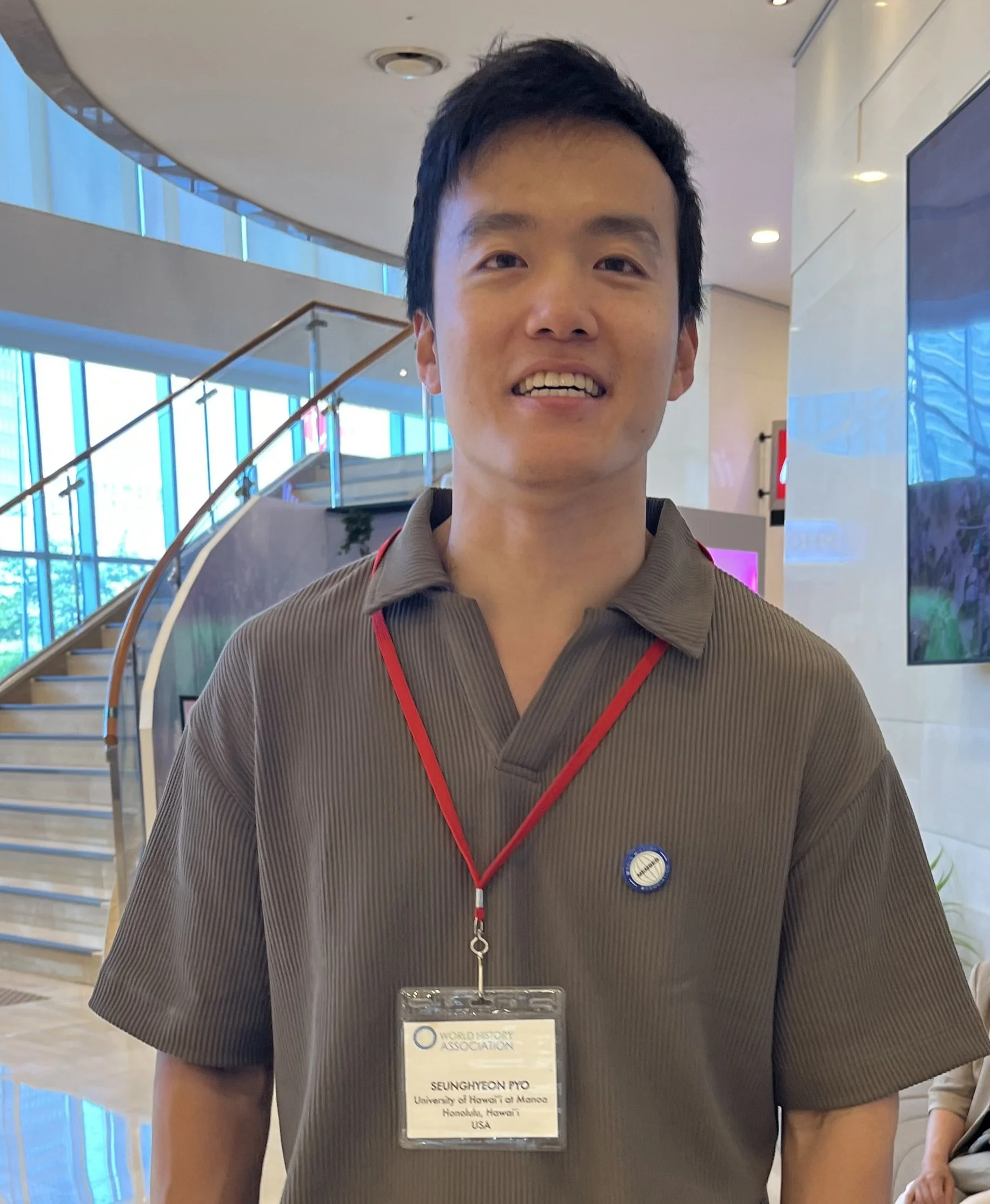
SeungHyeon Pyo (University of Hawaiʻi at Mānoa)
Lines of Sound, Lines of Nation: Ueda Kazutoshi, the Neogrammarians, and the Transnational Grammar of Modernity
SeungHyeon Pyo’s essay compares the Neogrammarians’ 1878 “manifesto” with Ueda Kazutoshi’s 1895 lecture notes, Nihongogaku no Hongen, to show how linguists in Germany and Meiji Japan used shared, international scientific methods to present the national language community as natural and law-governed. It argues that national languages emerged not in spite of the transnational regime of science, but as its by-product.
SeungHyeon Pyo is a PhD candidate in History at the University of Hawaiʻi at Mānoa, and a Japan Foundation Doctoral Fellow and Visiting Researcher at Osaka University (2026–27). Drawing on linguistic anthropology and semiotics, he studies how language became an object of science. His dissertation is a history of linguistic science in the making across nineteenth-century Germany and Japan, from Dutch Studies (Rangaku) and early modern translation to Sprachwissenschaft and academic linguistics (gengogaku). It asks what the new discipline inherited from earlier language scholarship and what it rhetorically eclipsed. At its centre is a phonocentric science that remade fluid vernaculars into national languages.